
Reversible Mobility: How Four-Wheel Steering Supports Urban Infrastructure’s Reliability and Comfort

While some high-end luxury cars
adopt Four-Wheel Steering (4WS) to
enhance cornering performance, for
AGT (Automated Guideway Transit)
systems operating above our streets,
this technology is far more than a
luxury. It has been a vital "survival
strategy" since the system’s
inception, allowing trains to navigate
the tight, complex spaces of the
modern city with ease.
Unlike 4WS in passenger cars, where
the rear wheels steer only slightly for
better handling, AGT’s steering is
incredibly dynamic. Because AGT
requires "reversible" characteristics—the
ability to travel forward and backward
at the same speed—the front and rear
wheels must steer at the same angle in
opposite directions.
The technology supporting this
movement has evolved from the early
"link system" to the modern "bogie
system". This transition to the bogie
system brought value far beyond a
simple mechanical change.
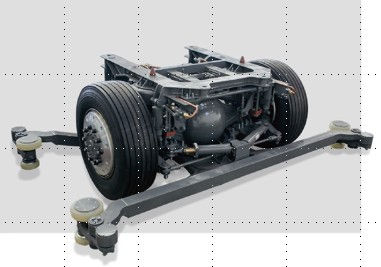

The greatest advantage of the bogie
system is the significant reduction in
the number of parts compared to the
link system. Fewer parts lead directly
to higher system reliability. For urban
public transit where failure is not an
option, this simple yet robust structure
is the key to fulfilling the promise of
"never stopping" for the residents it
serves.
Furthermore, this system created a
major secondary benefit: the ability to
design a wider car body. The extra
inches of space gained through bogie
optimization have fundamentally
enhanced passenger comfort for
millions of daily commuters.
The adoption of 4WS and the
innovation of the bogie system reflect
AGT’s history of meticulously building
"reliability" and "comfort" from the
smallest details of its undercarriage.
Today, this reversible mobility
continues to ensure that the city’s
lifeblood circulates smoothly and
without interruption.
Stay tuned for the next AGT Blog!