
Risks in the Front-Row View: Building an "Invisible Wall" to Protect Driver Safety in AGT Systems

The front row of an AGT vehicle is a
"special seat" where children can
watch the scenery with sparkling eyes.

However, when the control panel is
opened for manual training or practice,
it transforms into the most unprotected
driver’s seat in Japan.

As someone who loves watching the
tracks from behind the driver, I have
recently been pleased to see an
increasing number of female drivers on
manned AGT lines, such as the New
Shuttle and the Yukarigaoka Line.

Conventional manned AGTs and
monorails have sturdy partition walls
separating passengers from the driver.
However, AGT vehicles designed for
automated, driverless operation lack
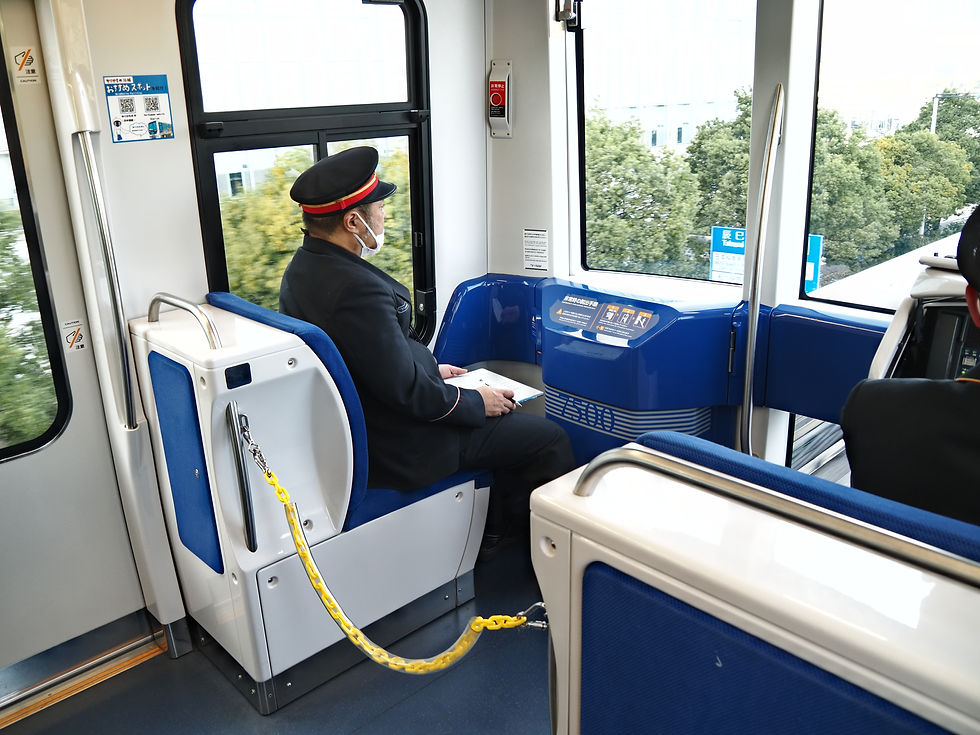
these walls. Since the driver’s
console is typically tucked under a
passenger seat panel, the driver sits
at a "zero-distance" from the
passengers immediately behind and
beside them.
While this openness is a core charm
of AGT, it also exposes drivers
—particularly female drivers—to risks
such as trouble with unruly passengers
or sexual harassment. To ensure
safety during training, current
operations must implement measures
such as having a second staff member
sit in the auxiliary seat, lowering roll
curtains, or installing temporary
partition bars.

The entire public transportation sector,
especially the bus industry, is currently
facing a severe driver shortage. To
encourage more women to join the
workforce, there is an urgent push to
create safer environments, including
the installation of security cameras and
improved rest facilities.
It is an undeniable irony that AGT’s
rational design—removing the driver’s
cab to maximize passenger space
—becomes a barrier when human
intervention is required. Investing in the
protection of the people who support
our infrastructure is no longer just a
"benefit"; it is an absolute requirement
for the sustainability of public transit.
Because AGT pursues "half-mile
kindness" for its users, the system
must also be kind to those who
operate it. To maintain the beauty of
an AGT system without physical walls,
we must instead build an "invisible
wall" of social awareness to protect
workers from harassment.
I hope you look forward to the next
AGT Blog!