
Why Did Rokko Liner Revert to a "Retro" Design? — The Strategic Intelligence of Space-Liberating Pipes
- 7月9日
- 読了時間: 2分

Following the 2005 Fukuchiyama Line
accident, pipe-style seat partitions
largely disappeared from Japanese
commuter trains. To prevent injuries
during collisions, many operators
switched to large, solid plates. This
trend extended to second-generation
AGT (Automated Guideway Transit)
vehicles as well; most modern cars,
led by the Yurikamome 7300 series,
adopted reinforced glass partitions.

This approach is a highly rational
modern solution, achieving safety
while maintaining visibility to reduce a
sense of confinement.
In this "era of glass," the Rokko Liner
3000 series, introduced in 2018,
made the bold choice to return to a
single, simple pipe.
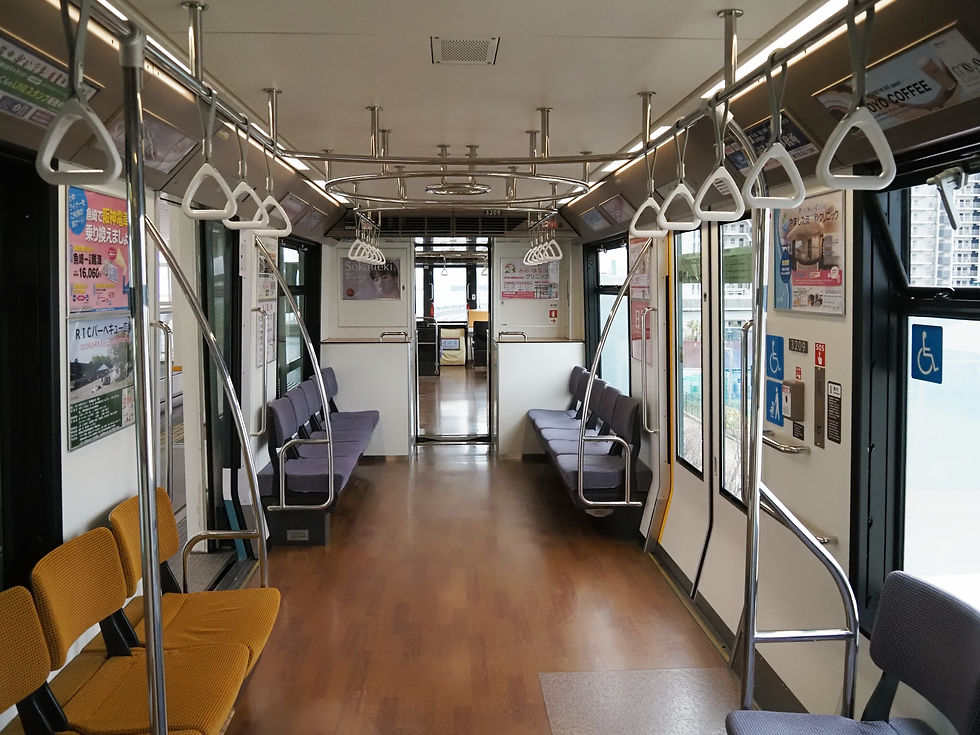
While it might look like a step
backward at first glance, it is actually a
calculated move based on a calm
analysis of AGT’s unique
characteristics. Because AGT runs on
dedicated tracks with zero level
crossings and operates at speeds
below 60 km/h (approx. 37 mph), the
theoretical risk of collision with other
vehicles or cars is extremely low. This
absolute confidence in the system's
inherent safety allowed designers to
strip away even glass plates, which
they viewed as "walls" that partition
the space.
Rather than simply following
standardized safety norms, the Rokko
Liner chose "active safety" derived
from a scientific understanding of its
own environment. By minimizing
partitions to a simple pipe, the interior
becomes an overwhelmingly spacious
environment, free of both physical and
visual "walls". This single, slender
pipe embodies a sincere strategic
intelligence: the decision to eliminate
excessive barriers and provide
passengers with true freedom within
the urban infrastructure.
The choice between "transparency
through glass" and "continuity through
pipes" is not a matter of which is
superior. It is a reflection of what a city
and its infrastructure intend to deliver
to their passengers. The next time you
board the Rokko Liner, take a
moment to feel the unobstructed view
and sense of openness beyond that
slender pipe. That "ultimate simplicity"
is the finest form of hospitality chosen
by the community of Rokko Island.
I hope you look forward to the next
AGT Blog!
becomes an overwhelmingly spacious environment, free of both physical and visual "walls". This single, slender pipe embodies a sincere strategic intelligence: the decision to eliminate excessive barriers and provide passengers with true freedom within the urban infrastructure.
The choice between "transparency
through glass" and "continuity through
pipes" is not a matter of which is
superior. It is a reflection of what a city
and its infrastructure intend to deliver
to their passengers. The next time you
board the Rokko Liner, take a
moment to feel the unobstructed view
and sense of openness beyond that
slender pipe. That "ultimate simplicity"
is the finest form of hospitality chosen
by the community of Rokko Island.
I hope you look forward to the next
AGT Blog!