
Why Is the Nippori-Toneri Liner So Congested? — What 5-Car Trains and Platform Lengths Reveal About Future-Proofing

The Nippori-Toneri Liner is known as
one of the most heavily congested
transit lines in the Tokyo metropolitan
area. While many assume that
Automated Guideway Transit (AGT)
systems inherently face severe
congestion due to their medium
-capacity nature, the current
overcrowding is not caused by the
system's technical limits, but rather by
a lack of foresight during the planning
phase.
Looking at AGT lines across Japan,
four lines operate with 6-car train sets,
led by the Port Liner, while another
four lines, including the Rokko Liner,
run 4-car train sets. In contrast, the
Nippori-Toneri Liner operates on an
irregular 5-car configuration. Typically,
longer lines with 11 or more stations
feature 6-car trains. It remains a
significant question why the Nippori
-Toneri Liner—built with 13 stations
from the outset—was planned with only
5-car trains. A striking contrast is
Osaka's Newtram, which opened with
4-car trains across 10 stations.

To anticipate future demand growth,
its station platforms were proactively
constructed long enough to
accommodate 6-car trains.
Like Yurikamome, the Nippori-Toneri
Liner introduced large-format,
two-door train cars (2.58 meters wide
and 8.5 meters long), increasing
passenger capacity by approximately
7% compared to earlier single-door
models. However, reducing the train
set from Yurikamome’s 6 cars to 5
resulted in an immediate 20% drop in
overall transport capacity. While
Yurikamome carries over 120,000
passengers daily and the Nippori
-Toneri Liner serves over 90,000, the
Nippori-Toneri Liner’s platforms were
built strictly to fit 5-car trains, making
it impossible to lengthen the trains
later.
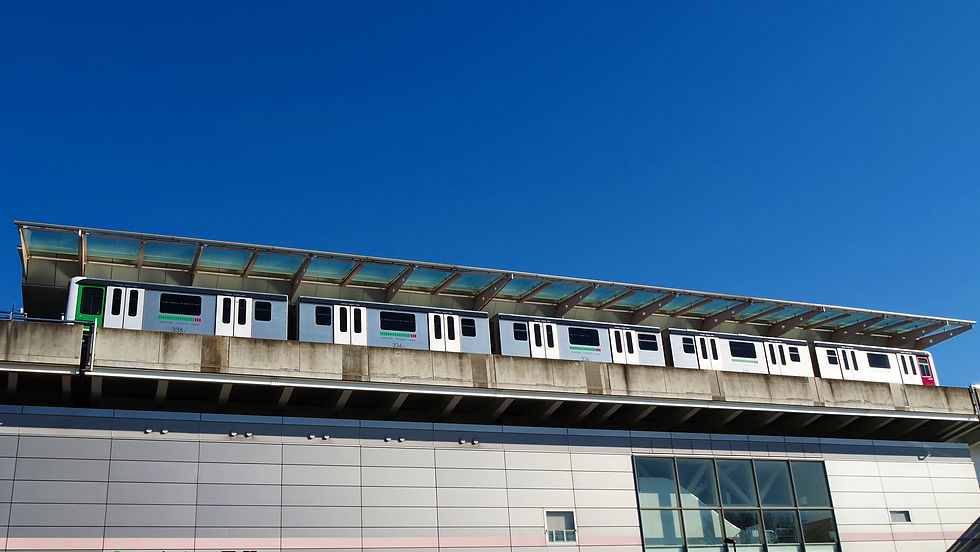
Although operators have attempted to
address demand by shortening
headways and adding fleet units,
physical space constraints at the
railyard have pushed operations to
their absolute limit.
Had the Nippori-Toneri Liner retained
"room to grow" to accommodate
6-car trains in the future, as the
Newtram did, today’s severe
congestion might well have been
avoided. The challenge facing the
Nippori-Toneri Liner is not a difference
in system performance inherent to
medium-capacity transit, but rather the
outcome of how much scalability and
future-proofing were built into the
city's infrastructure planning.
I hope you look forward to the next
AGT Blog!