
Why Piggyback AGT on "Passing Mega-Infrastructure"? — How Infrastructure Coexistence Design Offers Solutions for Developing Nations

While expressways and Shinkansen
bullet train lines passing through
urban areas serve as vital infrastructure
supporting wide-area mobility, they of
ten end up being perceived by local
residents as "structures that merely
pass overhead without offering direct
local benefits". However, if Automated
Guideway Transit (AGT) tracks are
incorporated from the planning stage
of these massive structures, limited
urban space and construction budgets
can be utilized to their fullest extent.
Japan offers numerous concrete
examples of such "infrastructure
coexistence". For instance, on the
Newtram line running alongside the
Hanshin Expressway Route 4 Wangan
Line, the large piers supporting the
expressway directly support the AGT
tracks between Nanko-higashi and
Port Town-higashi stations.
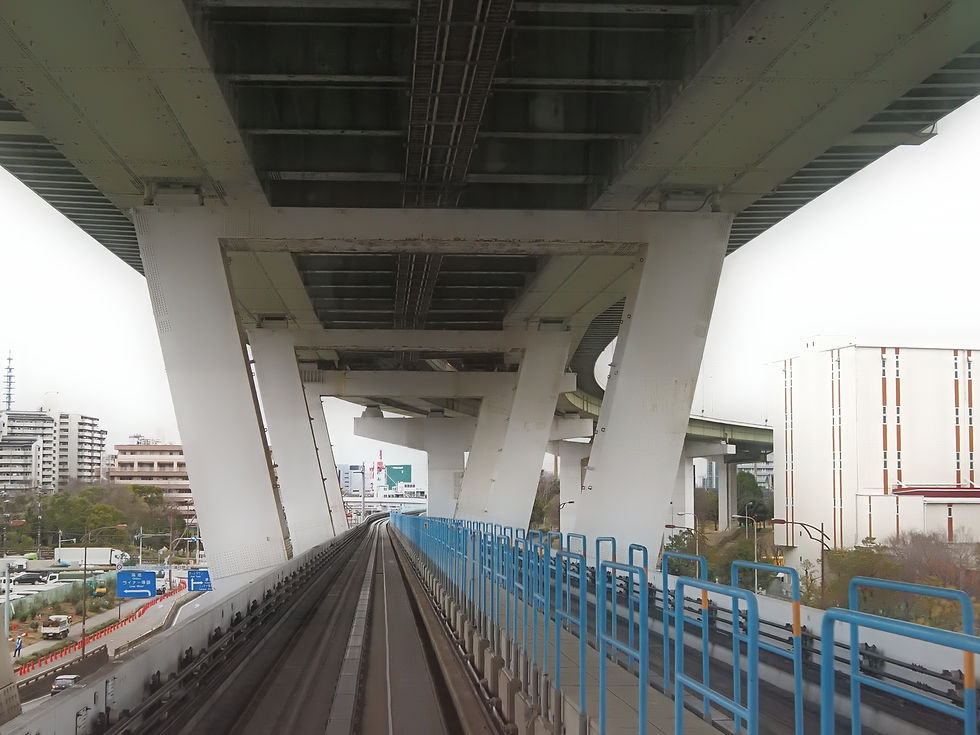
Similarly, the New Shuttle, which runs
along the elevated structure of the
Tohoku Shinkansen, has its tracks
supported by cantilevers protruding
from the Shinkansen's elevated piers.

Furthermore, Yurikamome on the
Rainbow Bridge was constructed as
an integrated structure featuring the
expressway on top, Yurikamome
tracks below, and local arterial roads
on both sides.

The common thread among these
examples is that they share the most
expensive elements—right-of-way
(land) as well as piers and girders.
Compared to building separate
elevated structures, this eliminates the
need for independent land acquisition
and significantly reduces foundation
construction costs. Designing AGT "
as a package from the outset" with
major transport corridors, rather than
constructing it as a standalone facility,
is the ultimate key to dramatically
lowering construction expenses.
This "coexistence design" approach
serves as an extremely powerful
solution for developing nations facing
severe traffic congestion and budget
constraints driven by rapid
urbanization. When planning new
expressways or urban railways,
assuming the inclusion of AGT from
the start enables the concurrent
development of medium-capacity
transit that directly serves local
residents on a minimal budget. The
advanced spatial utilization techniques
cultivated in Japanese urban transit
hold immense potential as a
sustainable model for solving global
urban challenges.
I hope you look forward to the next
AGT Blog!